Showing posts with label gardens. Show all posts

Tuesday, June 10, 2014

Farm Tour

This past Saturday we hosted a farm tour at moonCatlife. Jerome showed everyone around our beginning food forest and I took a turn showing building and retrofit projects. Phoenix showed everyone the kittens. I enjoyed making some new friends in the area. 

I have been hoping to project some movies in the barn and one of our visitors just so happened to have an old screen lying around. After connecting with a belly dancing instructor I am hoping to get some lessons going here along with yoga and meditation.                                   

We walked on our new paths that Darrell spent so much time mulching and looked at the new apple trees. The apple area also has a mix of herbs and some transplanted gooseberry bushes and wild grapes. I wanted to try a couple of hardier pecan and almond trees in this area as well so we planted them here.

The apples were planted next to a group of trees that grew over a large strawberry patch. There are mulberries, more wild grapes, rye, and some asparagus as well as other wild edibles of the area such as wood sorrel, lambs quarters, and milk weed (pods).  Clover and medic are growing throughout fixing nitrogen, drawing bees, and smelling wonderful.

This year Jerome has added a couple of pigs to our permaculture system and they are clearing the land for planting in our "pig tractor".  I added some swales for redirecting rain water.  We planted larger willows to boarder the farm that should have more stamina than smaller starts from the past. A path is in progress next to the willows now.

We enjoyed sharing knowledge and learning more tid bits about wild edibles and other natural ways of living from those who came.
 Here's to friends, nature, and innumerable possibilities.

Monday, July 2, 2012

bike trip to mississippi palisades

   
  Our bike trip started out as a trip to Thomson to see a cheese-making demonstration at the newly opening Heirloom Cafe. Mark and Catherine told me that the presenter would be using their raw milk, and I was specially interested because I have been wanting to do just that. Then I suggested that we bike there, then one of us suggested that we just continue on to the Palisades and camp there.  So Saturday morning Jerome and I took off on his Next bike with a trailer for sleeping bags etc. and the battered Schwinn that we found laid out for trash that Bill fixed up.


We arrived a little late and missed the cheese-making, but I appreciated the chance to visit Thomson Heirloom Solutions where they sell Heirloom seeds and solar harvesting equipment.  I listened to Nick (seed connoisseur) and Jerome talk about gardening, farming, as well as chipping in some questions here and there. Next we stopped through to visit a bike shop that we had passed, Arnold's Bikes and Embroidery. The owner, I can't remember his name right now, but I know the last name is Arnold, let us play on his recumbent bikes and even ride his own bike. It was so fun! I am in love with recumbent bikes now. He also put some grease on the bearings of the rear wheel of the Schwinn for us so that it would stop that weird grinding noise it was making intermittently.  He came out with some copper wool and said that Schwinns are known for their chrome, scrubbing the rust spots right off. Then he sent the copper wool with us and told us to shine it up while we were camping.  
[dragonfly coming out of nymph stage at the river]


We continued on the Great River Bike Trail to the Palisades, altogether around 25 miles on a hot day and then jumped into the Mississippi where we hollered and waved to people at the Palisades lookout, snacked, rested our sore butts, swam, and made hair extensions out of sea weed (is it called that in the Mississippi?). I had gotten hungry/hot grumpy but the water made me feel better. Our intention had been to camp at the Palisades but the mosquitos were horrible at night (and we were sleeping in a hammock and sleeping bag, no tent) so we left our campsite in the middle of the night to head back and find somewhere along the way to lay out our bags where there might be a breeze or less mosquitos.

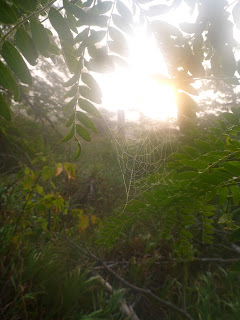

[view from where I woke up]

The ride in the dark was amazing! To the left was the park with fireflies scattered throughout the trees, to the right was the river and fog. After a bit a train rode next to us, offering one of those timeless feelings. It was one of those magical times where I was reminded of what true beauty there can be in the world.  We found a stopping place off of the side of the road a couple of hours in, and hiding our bikes in the trees slept very comfortably until sunrise when we took off for home.  We ate some wild blackberries and mulberries along the trail and snapped pictures of other plants we will look up later.


Upon arriving home we were told that Zac, Tuara, and Sabastein had gathered 18 eggs the day before, so of course we devoured some and fell asleep. My body feels fantastic after that trip now that the saddle-sore feeling has faded. We have decided that next time we won't bring the trailer and we will bring the tent--strapped to a bike.  It was definitely a beautiful trail that I would love to bike again sometime.

There's nothing like nature to help me fall back in love with my life when I'm feeling burnt.


Wednesday, March 28, 2012

hoobastank culture, I mean . . . hugelkultur


    Hugelkultur: article below from the website http://www.richsoil.com/hugelkultur/

    a page on permaculture methods

    garden beds: hugelkultur instead of irrigation

    raised garden beds hugelkultur logs and soil after one month

    raised garden bed hugelkultur after one month

    hugelkultur

    raised garden bed hugelkultur after one year

    raised garden beds after two years

    raised garden bed hugelkultur after two years

    raised garden beds hugelkultur after twenty years

    raised garden bed hugelkultur after twenty years


    hugelkultur raised garden beds in a nutshell:

    • grow a typical garden without irrigation or fertilization
    • has been demonstrated to work in deserts as well as backyards
    • use up rotting wood, twigs, branches and even whole trees that would otherwise go to the dump or be burned
    • it is pretty much nothing more than buried wood
    • can be flush with the ground, although raised garden beds are typically better
    • can start small, and be added to later
    • can always be small - although bigger is better
    • You can save the world from global warming by doing carbon sequestration in your own back yard!
    • perfect for places that have had trees blown over by storms
    • can help end world hunger
    • give a gift to your future


Jerome ran across hugelkultur in a Sepp Holzer book on Permaculture. We have a lot of tall weeds and some rotten wood around the farm. As mentioned above there are many immediate benefits as well as carbon sequestering. Carbon sequestering helps to prevent further buildup of Carbon in the atmosphere from the decay of the wood. In a way lessening the growth of the greenhouse effect in the atmosphere.

The compost that we added on the top of our raised beds on wood/woody weeds is from the city of Davenport. The city has a compost facility where residents can drop off "yard waste". They then compost these clippings and sell the compost. I like the idea of supporting a city compost system.

I looked into the different organic mixes the city offered. One was mixed with sludge from city waste facilities sometimes referred to as "biosolids" (though biosolids are sometimes differentiated as having gone through more of a treatment process than the general term "sludge"). There seems to be quite a controversy about gardening with sludge. This link shows a little about the sludge controversy. We got the compost without sludge, but unfortunately this type no longer comes in bulk. We will, however be re-using the bags in the bottom of our pounded tires.

The beds in this picture are planted with lettuce, kale, and swiss chard. If you look closely at the top of the photo you can see some of the rotten wood we are putting inside the piles. These beds are between buildings where the greens will receive partial shade. Last year the heat caused our lettuce to bolt pretty quickly in the sun, but this year it will be more shaded.


Saturday, August 20, 2011

illinois renew: PV and Native Plants

We had a chance to stop through the Illinois Renewable Energy fair in Oregon, Illinois, last week. I was very excited to go and meet some like-minded people.

We made it to a presentation on Photovoltaics that was informative. It was about maximizing the energy from your solar panels. The end of the presentation got drowned out in the sounds of rain and hail from feisty weather. It is always encouraging to see what others are doing in your area though.
I enjoyed learning about some of the challenges of solar power and some innovations that help overcome them. I've got some fun notes and I'm sure I will be looking more into this PV group that services the midwest: Advanced Solar Solutions.

www.AESsolar.com


Next we sat in on a presentation about why it is important to grow native plants in your lawn. It was called "We all live downstream". The presenter, Tim Lewis, talked about the importance of the root systems to filter ground water and prevent erosion. He also talked about how native plants support native insects that help to balance a healthy ecosystem.

Tim obviously had a personal vendetta with the "traditional" american lawn. Although, I can't say I disagree. I think that lawns are a waste of time and resources. The shallow root system alone causes environmental degradation, not to mention chemical fertilizers and fossil fuels used to keep it trim and green. Jerome told me about a group called food-not-lawns that I find intriguing. I learned from the presentation that grass is actually the largest crop in America, covering 30-40 million acres of lawn surface. Imagine if everybody grew some of their own food instead of caring for a fruitless lawn.

According to Tim Lewis, the current traditional American lawn is actually a throwback to the 1700's. In England it was a status symbol. The lawn took off in America right after World War II. Now there are laws about the necessity of taking care of one's lawn. As people are learning more about the hazard of current lawns though this is changing. The association for native plants refers to a lawyer who will help people fight for their right to plant native species to nurture their ecosystem.

We ended up having to leave early because of the rain and storms and a sick little one. I was disappointed to not be able to return on Sunday, but Phoenix just started school and seems to have already caught a virus. I stayed home and took care of her while Jerome got a chance to go back and pick up some of the native food-bearing plants (hazelnuts, serviceberries and more) we had planned on getting at the fair from Red Buffalo Nursery (http://www.redbuffalonursery.com/).

I will make another post later on what we got to see at our time at the Illinois Renewable Energy Fair! We had a long day today picnicking and playing at Eagle Point Park in Clinton with the girls. We ate at the top of a small castle next to a wedding and played at the multiple playgrounds. We relaxed on a blanket, had a treat and read a story. Then the kids went back to play while the adults relaxed with some yoga and Thai massage before a small hike. I'm ready to relax at home with some candlelight and local wine.