Showing posts with label sustainability. Show all posts

Monday, August 17, 2015

Natural Cottage Project, Burton Ohio,

Phoenix and I have managed to meet up with our friend and natural building instructor Uncle Mud a couple of times this year. We recently were able to make it to his project in Ohio with co-Natural Cottage Project instructors Christina Ott and Deanne Bednar.

NATURAL COTTAGE INTENSIVE

CIMG9089

2 Week Cottage Build
July 10-24 2015


It is always a pleasure to see this crew. Chis' (Uncle Mud) family has a way of drawing everyone together to feel like a big family. After the build, my 8-year-old, Phoenix put together this inspiring video of her experience:


I chose not to edit because I liked it how it was ;) Great job Phoenix

Sunday, November 30, 2014

Biochar plaster

I fell in love with earthen plasters during my cob course. It is nice to have a building material that you can wash out on the ground right next to your garden. It is nice to know what is in your home is not toxic to anyone, and the production of it is not creating any toxins elsewhere in the world.

It is nice to be able to source materials locally, to dig up my materials from the ground. This is much more affordable as well.


I have worked with clay based plasters and lime based plasters, and recently was introduced to biochar plaster. At the Ecovillage Training Center at The Farm in TN, Albert is the biochar man. I have to admit a little skepticism when first introduced to the concept of biochar, but there are so many people who report amazing results that I am sold. 

Recently the permaculture apprentices at the Ecovillage Training Center applied some clay based biochar plaster in The Prancing Poet (event space).  Albert mentioned that the biochar blocks electromagnetic radiation such as those that come from computers, microwaves etc. I was curious so I looked around and found a very interesting article on biochar plaster. 

Biochar as Building Material for Optimal Indoor Climate


The article mentions that biochar plaster is being used to restore old wine cellars. It regulates humidity for the wine, helps stabilize the temperature, and filters the air. 

I had yet to complete a final plaster coat on the cob bench around our woodburning stove, so I decided to do my own experiment.

I chose to use a 50/50 lime and masonry sand mix. with at least 20% biochar. The biochar was beautiful when wet, bluish-black. As lime plaster does, the biochar mix still smoothed into a nice finish after burnishing, looking almost like stone. 

I did have to baby the plaster a bit because humidity was low in the cold air, and I wanted to keep the cob at an ideal temperature for lime plaster curing so that I did not get large cracks (the last lime plaster I did was in ideal humidity and temperature and did not require water spritzing regularly as this mix did).

The plaster turned out great. I head to leave and come back to the Ecovillage Training Center, so I asked my husband to continue to spritz it for a week and keep an eye on it, then slowly decrease frequency of spritzing while it cured the our cold temperature with the stove running. I am very curious of the effect of the humidity regulating biochar on the lime plaster, but would need to try the plaster in different conditions to know that the change was related to the biochar in particular. 

I hear it is doing great and am looking forward to further biochar plaster on the walls. I will be keeping an eye on summer humidity in our home. I am looking forward to some changes in this!

Next time: More fibers, try a natural tint, do this plaster when it is warmer out!

Monday, September 22, 2014

Monmoth Food Forest Tour

This posting is mostly to keep my own notes, but why not share what I learned on a tour of a Food Forest? Enjoy and ask questions!
Gary Fernald started planting trees near Monmoth, IL in 1967. He was inspired by Pecans and they've become his expertise. He found there was a need to establish or re-establish locally verdant groves to nourish and thrill people. So he went looking.
Hazelnuts in the husk
Northern Pecans can be massive trees. Some were found on Adams Island near Clinton, IA. Also along Rock Creek and Pleasant Creek. These areas are closed in the fall (Sept. 15 to Jan) for waterfowl, but Gary was able to get a permit from Army Corps of Engineers and Fish and Wildlife to gather nuts to plant groves elsewhere in order to preserve and breed pecans. He planted groves north of Chestnut Mountain and by Muscatine, just by the lock and dam below the Gorham residence.

Gary has bred many trees and there are even some cultivars named after him for sale from tree catalogs. Two that we saw on our tour were Hark and Lucas.
Japanese Heartnut - this nut can be shelled whole.
More Notes:
The Hican (sp?) A cross between a hickory and pecan can occur naturally. Some pecans bear hickory (shagbark) traits. Not as productive as pecan, but can be more flavourful.
English Walnut
Regarding English Walnuts, they are hard to do. Some produce OK. They are also different (bearing) year to year. English walnuts are easier to crack and will fall out of husk onto ground. Chris Knows a tree that drops nuts onto a sidewalk in the Quad Cities and they just pop out of the shell! I should ask him for a graft...
Chestnut trees with their prickly husks.
Mulberry: Illinois ever-bearing might be one of the best species of mulberry – I need to graft this onto existing trees on the farm!
Pawpaw - unfortunately not ripe in time this year
Grafting: Keep grafts at 80F to “callous” use ~6” of scion (fruiting stock) with buds onto rootstock. Use a sharp knife or bench tool. Bench graft with pencil-sized stock. Bark graft several pencil-sized sticks into side of bark of 3-6” branch, trimmed of growth just above graft. Wrap with just about anything, electrical tape works well. Grafted (any) can produce in 3-5 years (walnut, pecan, etc.) Practice to get good at these techniques and let someone show you that knows what they are doing. Gary may have a workshop coming up! Butternut and English walnut can be grafted onto Black walnut!


Wednesday, January 8, 2014

The Farm

When I took my cob course in Tennessee this past October I noticed that an eco-village training center I had seen online was a close drive.  We had one day off in the middle of our course and a couple of my fellow eco-geek girls came along to check out The Farm with me.

Now, as much as I am interested in intentional community and eco-villages I get a little uncomfortable with words like commune and fascism. Though, realistically if you dive into philosophy of fascism versus what has actually played out it really is full on interesting concepts, and really, what was Marx actually saying? Fun debates.

 I want to live somewhere that people share because they choose to, where independence is valued, but community flows freely as choice.  Somewhere that people are valued and supported to realize their full creative potential by rising above the rat race and ensuring basic needs are met; these are the strengths I see in a sharing community. These are things I have gained from intentional communities in the past, though I have never been a member of a common purse. And while I'm on a role, I think that it is more important to realize my own equality and see what flows from there than to assume "the man" owes me equality.  I do, however, have respect for those that strive for equality and create communes that work and create conscious change, but have seen a lack of individual "ownership" transfer to a lack of respect for property, and sometimes scarcity. This is where my mind flows when I think of "communes".

 Stained glass dome at The Farm


I am intrigued by the story of The Farm as it morphed from commune, to intentional community to become self-supporting. Googling for more precise definitions I found this fun link to explore the definitions at planetfriendly.net

The eco-village training center at The Farm has a number of natural building projects going. I bumped into Jason "the green resourcerer" and he explained one of the eco-village projects to me that included fun building techniques I am interested in like straw slip, in-floor heating, more cob, bamboo, cordwood, and sawdust for insulation.  They were using cordwood to tie together two layers of cob with a space in the middle filled with sawdust for insulation.

Lion sculpted out of cob


The Farm has so much interesting history to share with anyone interested in different forms of sharing economies from co-housing to full blown communes. Now it has a midwifery center (that I did not get to visit yet) and the visitor's center is full of interesting resources . . . I just wanted to take pictures of the bookshelves and start googling subjects & authors . . .and a bookstore where I got one of my new favorite books Ecocities, rebuilding cities in balance with nature by Richard Register. 

 Slip straw I have been told works well as insulation

Cob sculpted fireplace 

Compost toilets & solar shower with Dawn

I would love to go back and experience more of their eco-village training center, natural building, vehicle conversion, and midwifery clinic.


Monday, January 6, 2014

heated Cob bench & thermal mass

I am really really starting to love the concept of thermal mass. The first time I heard about thermal mass was from Earthships. The tires and the berm around an Earthship provide thermal mass that acts as a temperature battery storing the heat or cold that you expose it to (integrating passive solar/south facing windows etc. to heat it up in cold times).

Deanne introduced me to a rocket stove DVD with Ernie & Erica Wisner and Paul Wheaton. It is expensive, but is a 4 DVD set with lots of information. In the DVD they discuss all sorts of good stuff relating to heat, fire, thermal mass, convection/conduction/radiation, and efficient heating. I went in with a friend to get the DVD and feel it was very worth it. I have started to think of heating homes differently.

I used to be one of those people who felt slightly frozen in the winter because heated air just didn't seem like enough to me. I felt I needed to soak in warm water or touch something warm to really soak in the heat (or gather my ambition for some kundalini yoga). Now I have learned that heating the air (convection) is likely the least efficient form of heating. Then we seal up houses to keep the warm air in and end up with stale allergen populated air.  No wonder everyone has allergies.

Heating thermal mass, which slowly releases the heat is heating by radiation and is very efficient. My body really likes this. Who doesn't like sitting on a warm bench in the winter . . . not counting menopausal women. Also, the heat is more regulated.  In the DVD someone mentions a house in Norway or Sweden that is heated with a masonry heater (using the concept of thermal mass & heating with radiation) and has free airflow to the outside just below the roof, staying plenty warm.  There are all sorts of ways to heat thermal mass from fire, to passive solar & glycol panels with in floor heating, and even in floor electrical heating mats (ease of installation & use but less efficient).   There are varying densities of thermal mass, from cement slab, even tile, to cob, and stone .  . . and so much more.

This all works up to: we are working on a heated cob bench, or two. The cob and stone help to store heat inside the house so it is not whisked out of the house if the door is opened or windows are not perfectly sealed.  The more thermal mass you have the more your desired temperature wants to stick to your living space.

One is in the entry room/inner almost-soon-to-be greenhouse.
The thermal mass is made of local limestone from a quarry and cob (also a nice sand & clay mix from a local quarry).
 Top picture is what we started with. We decided to take out the closet & table (doors are already off of the closet).
Everything is out. We tiled the walls. The bench goes in in a "U" shape.
Beginnings of a bench. We are having a cob mixing party tomorrow to bulk this up before sculpting and putting on a finish plaster coat. I'm not completely sure we will have enough materials to finish right now. The local quarries said that their stone is not accessible because it was frozen solid . . . our weather station said it was -17 degrees out this morning (without windchill factored in)! I hear this will be over soon though and I can access materials again.
The window between the bathroom and the entry room. I found these used glass floor tiles at the Habitat for Humanity Restore and knew they would fit the empty window frame perfectly; I just mortared them in. I thought about using bottle bricks but the frame is only about 1 1/2-2 in and the outsides slope. This was quick, easy, and fun. I like how it looks.

I will post a follow-up when the bench is finished!


tiling in retrofit

This past summer we had someone come to visit who is interested in intentional community. She stayed with us for a couple of weeks and we discussed community and our experiences with it and shared knowledge. While she was here Sarah Haas shared her tiling knowledge with us.

Sarah is a dancer who decided that she wanted to build her own home and performance structure that could go with her as she traveled the states.  When she told me she had interned with Dan Phillips I was excited to pick her brain because I had found his TED talk very inspiring. Dan Phillips gave a talk on building creatively with reclaimed materials in Texas.  While there Sarah gained a foundation of tiling knowledge and then expanded her knowledge to do some tiling professionally.

The first project we worked on was a small table. Sarah cut cement backer board and we used Versabond thin set mortar to set the prearranged (largely by Phoenix) scrap tile pieces in place. I know that when working with plasters and cement the right mix means lasting work. Knowing this is a good brand and how particular Sarah is about work that will last I will probably stick with this unless I hear otherwise.
The line of blue dragons' tears down the center Phoenix collected somewhere random.

Once the mortar had been given enough time to set (about a day or check label) we squished in a reddish grout. Sarah was a little nervous about staining the tile with a darker grout but Phoenix picked red and we decided to go with it. Once applied we sponged it off the tile within 2-3 minutes and then wiped any remaining grout off the tiles with a cleanish rag. There was very little staining. A couple of the white tiles had the tiniest amount of color change.  After grouting we used a water sealant, and quickly scrubbed it off the tiles before it could dry on them and make them look foggy. 

I showed a friend later how to tile a coffee table. It was much easier to grout when we were able to keep the tile pieces level by varying the amount of mortar on the individual pieces of tile. When using scrap tile the pieces have different thickness and keeping the pieces level not only makes grouting easier but minimizes sharp edges that could stick out. 


The table turned out amazing! Second project: stairs. We have a few stairs leading down to the kitchen that are made of wood. Each stair had a small lip that stuck out. Jerome said that this is because of a visual effect and how our brains interpret depth. People are more likely to trip without that extra lip, but it would be really hard to tile. So I got out the sawzall and butchered the stairs as I cut off the lip. Then we laid cement backer board to support the tile and create and even surface to prevent future cracking. 

The tile we used came partially from what Sarah brought that people had given her as scrap and what a friend had given us from someone else's left over tile. I decided I wanted to get creative and use our collection of bottle caps that Phoenix had claimed. This was fun but did take a little longer to lay the bottle caps. We cut tile for the step edges to that there would be not sharp edges.  This was the first time I actually used my tile saw for tile. Previously I had used it to cut glass for bottle bricks. 

 I took the most time on the top stair. At first I really got intricate and took my time . . . then I decided the stairs needed to get finished more quickly because they were being walked on and pieces were getting knocked off and sideways. . . so a number of people chipped in to make our small community stair mosaic.
 Phoenix designed the center that looks like a ship anchor/bird and Jerome finished it by grouting her creation. Before she left Sarah designed the golden cap portion near at the right that looks like a sun and the trees on the side. Phoenix and our WWOOFer Sam from Utah designed the sides of the top two stairs. A WWOOFer couple from Ohio helped to grout and water seal a couple of the stairs. Our neighbor Donna contributed clear marbles left over from tiling her coffee table (I love how these feel on my bare feet).

When applying the water sealant I used two different brands. The brand "Miracle" that Sarah recommended seemed to soak into the grout much better. The cheap brand kind of rolled around on the surface a lot and needed a lot more work to apply. 

I love sharing knowledge and stories. It is fun to read the stories in our mosaic. The point beer caps are from every time Jerome's family visits from Wisconsin. The bird tile is a hot pad I found at a local thrift store and grabbed because I wanted to copy the bird for a sketch. Gluten free cider caps tell their own story. Some of the scrap tile came from a CSA member who snatched up a bunch of tile a friend was going to throw away and shared with us.  Jerome probably knows more about the other beer caps, and maybe which WOOFers drank each. . . or maybe not, but I really like the bottle caps and would like to do more with them. 

I can claim that the tiling fits in with sustainability because we are repurposing scraps and "trash".  Done right tile can last a long time, which also is a form of sustainability.  A lot of floors include poly something or other, and maybe some of my materials do;  I think it is minimized.  There is a bit of a trade-off in the use of mortar and grout with embodied energy, but creating a creative and lasting mosaic is worth it to me.

Tile can also be laid in an earthen plaster, but our home is in the midwest and partially in the ground so I want to avoid possible moisture issues by going with more traditional tile methods on the existing cement floor.  

Friday, December 6, 2013

the Strawbale Studio part II

Here is a video I found online where Deanne gives a brief tour of The Strawbale Studio.
She is offering internships in January and Feburuary!


This is a picture inside The Strawbale Studio sculpted out of cob. I like the branch added at the top. 
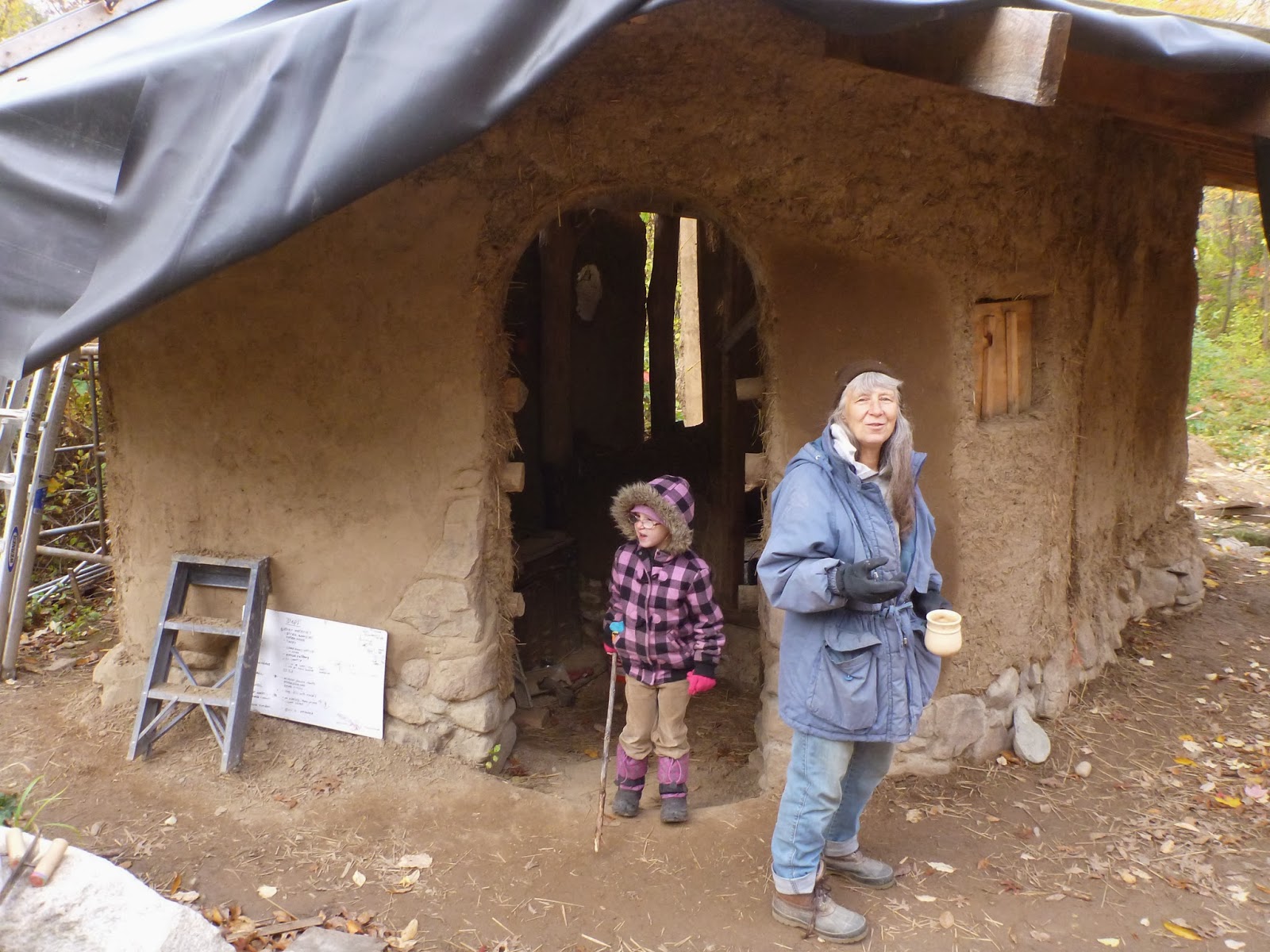
Deanne and Phoenix in front of the in-progress hobbit sauna.


Holes for pipe inside the sauna where the wood burning stove will go. 

A fish sculpted on the side of the rocket stove.


A spiral hut

A soon to be children's house 

Inside the children's house. The floor has the exhaust of the rocket stove running through heating it.

 Deanne at her rocket cookstove made of thrown together bricks
One thing I love about Deanne--everything is useful and everything is art.